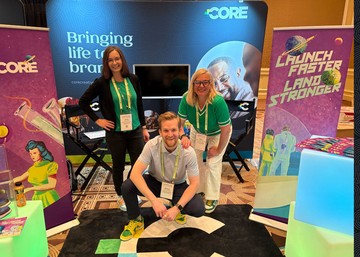
We had such a great time at the Healthcare Marketing and Physicians Strategies Summit (HMPS) earlier this week. We reconnected with colleagues and friends, made new connections and tried to absorb as many sessions as possible. There was no shortage of conversation around AI, from conversational search and predictive outreach to AI agents acting like consumers. But alongside all the talk about AI and innovation, another theme surfaced again and again: the growing erosion of trust in healthcare.
On the surface, those two themes feel at odds with each other. AI is pushing healthcare marketing toward more automation, more content and faster communication. And it’s happening at breakneck speed. Meanwhile, consumer expectations are changing, and they want more human, personalized, connected and trustworthy experiences.
But what struck us most at HMPS is that these trends are actually pointing healthcare brands toward the same path forward.
As AI continues to reshape how healthcare organizations are discovered, evaluated and experienced, branding matters more than ever. The brands that succeed won’t be the ones that simply adopt AI the fastest. They’ll be the ones that use it to become clearer, more empathetic, more authentic and more human.
In many ways, AI is forcing healthcare marketers back to the fundamentals:
- Clarity
- Empathy
- Authenticity
- Clear, defensible brand positioning
These are some of the biggest shifts and opportunities that stood out to us at HMPS 2026.
AI is changing how brands are discovered.
Consumers have wanted more seamless, personalized and lower-friction healthcare experiences for years. AI is simply accelerating those expectations and changing how people search for, discover and engage with healthcare organizations. Consumers are starting to replace traditional search with conversational AI, and AI-generated answers are influencing their decisions.
This is a big deal for brands. Brand “discoverability” has to extend beyond traditional SEO now. Healthcare organizations aren’t just communicating with people. They’re communicating with AI systems that are influencing how people find information and make decisions. Communicating with AI agents sounds scary, but they actually want the same thing that real people want: clarity.
AI agents don’t respond to vague positioning, inflated claims or generic marketing language. They prioritize specificity, relevance, proof and consistency. In the AI world, unclear messaging makes brands invisible. The brands that stand out communicate a clear value proposition and consistently deliver experiences that reinforce it.
The experience is the brand and the foundation for trust.
Another major theme throughout HMPS was the growing erosion of trust in healthcare. Consumers are overwhelmed, their experiences often feel fragmented — and access is challenging. Fragmented experiences create frustration, and now AI is adding another layer of uncertainty to the overall experience.
Another idea that came up repeatedly is that the experience itself has become the consumer assessment of the brand promise. That really resonated with us.
Trust isn’t built through messaging alone. It’s built across the entire experience and journey:
- How easy it is to access care
- How connected the experience feels
- Whether communication feels personal and empathetic
- Whether organizations deliver on their promises
- Whether consumers feel seen, understood and supported
This has major implications for healthcare marketers. Branding can no longer operate separately from patient experience. The experience is the brand.
Community Health Network demonstrated that AI can either strengthen or weaken the consumer experience. If you’re not careful, AI can add more noise and impersonal interactions. It can also make your brand feel less human. But when used strategically and intentionally, AI can help reduce friction, improve coordination and create more meaningful, personalized experiences at scale. That experience is ultimately what will build or erode trust
The age of AI is calling for a more human approach.
The rise of AI is actually pushing healthcare marketers toward a more human-centered approach.
Our world is increasingly filled with AI-generated “word soup.” We’ve all seen enough to sniff out AI-generated content right away. Authenticity is becoming more valuable than ever, and consumers are looking for brands with:
- A clear purpose
- Authentic positioning
- Meaningful differentiation
- Empathy
- Real proof points, not fluff
Authenticity is about having a clear purpose or “why.” It’s about consistently living your brand promise and values in ways that build trust over time.
We learned from so many speakers at HMPS that trust is what drives engagement, follow-through and outcomes. This was especially evident in conversations we attended around population health. Many organizations are doing meaningful upstream work — addressing housing, mental health, food insecurity and preventive care — but when the experience feels fragmented, disconnected or not delivering on your brand promise, trust and engagement fall apart.
The organizations that succeed will be:
- Clearer
- More connected
- More helpful
- More human
Closing thought.
HMPS 2026 showed us all the ways in which AI is changing healthcare marketing. For us, the biggest insight is that AI is forcing healthcare brands to become more intentional about what they stand for, how they communicate it, and whether the experiences they deliver actually live up to their brand promise.
In a world of more AI-generated content, more automation and more noise, the brands that win will be the ones that feel the most human.